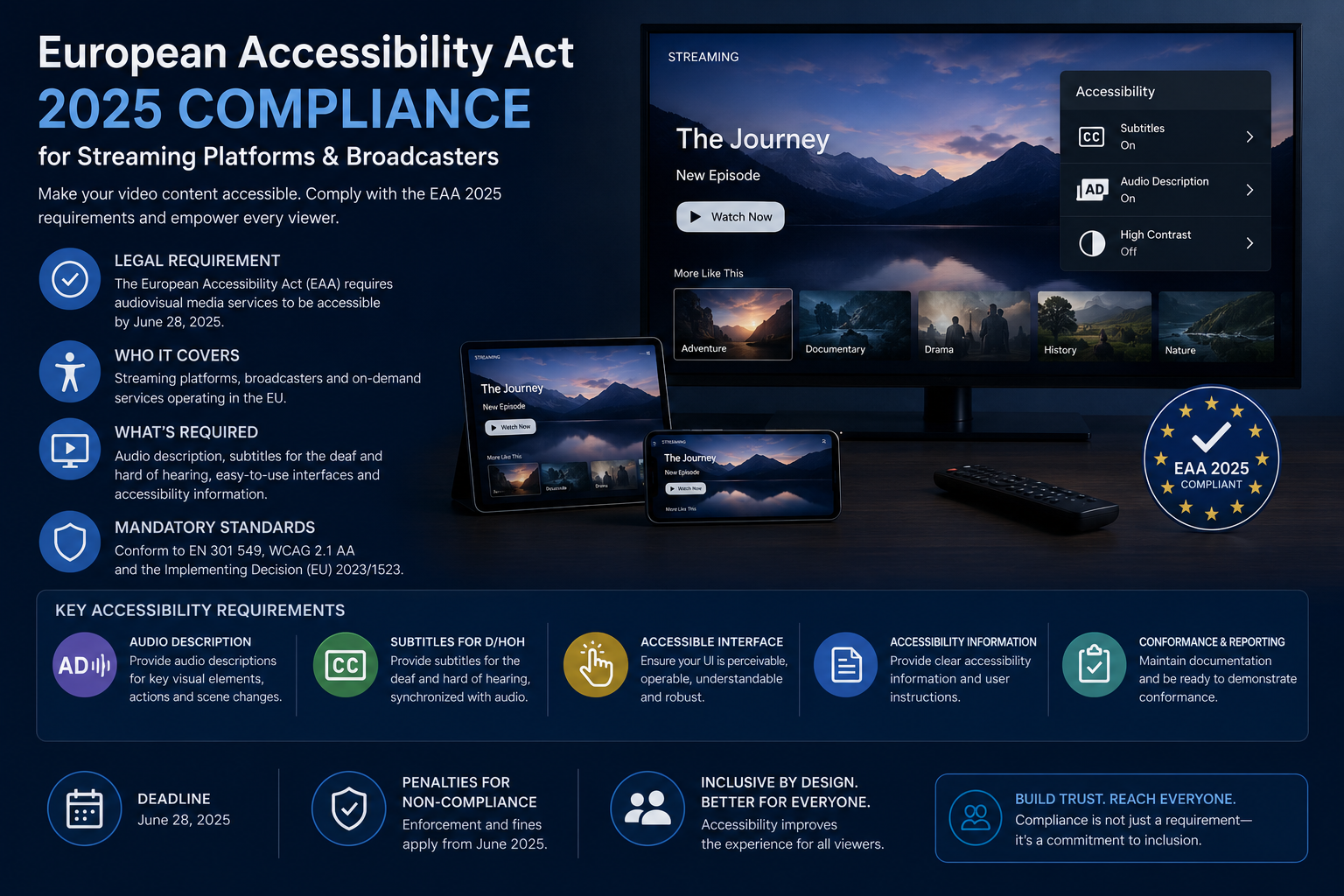
European Accessibility Act 2025: What Streaming Platforms and Broadcasters Must Do Now
The European Accessibility Act (EAA) — Directive 2019/882/EU — comes into full enforcement on June 28, 2025. For streaming platforms, video-on-demand (VOD) services, and broadcasters operating in the EU, this is the single most important compliance deadline of the decade.
This guide answers the questions we hear most often: what the EAA actually requires, who it applies to, what the penalties look like, and how to get compliant before the deadline.
What Is the European Accessibility Act?
The European Accessibility Act is an EU directive that sets harmonised accessibility requirements across member states for a wide range of products and services — from ATMs and e-readers to audiovisual media services. It replaces a patchwork of national laws with a single standard, making it easier for people with disabilities to access digital services across the EU and easier for businesses to operate cross-border.
The EAA builds on the EN 301 549 standard and aligns closely with WCAG 2.1 Level AA for digital content.
Who Does the EAA Apply To?
The EAA applies to any business that:
- Provides audiovisual media services (streaming, VOD, broadcast) to consumers in the EU
- Has more than 10 employees or an annual turnover above €2 million (micro-enterprises are exempt)
- Is established inside the EU, or targets EU consumers from outside it
This means Netflix, Disney+, Amazon Prime, and every regional broadcaster or independent streaming platform serving European audiences must comply.
What Does the EAA Require for Video Content?
For audiovisual services, the EAA mandates that content be perceivable to users regardless of disability. In practice, this means:
Audio Description (AD)
Pre-recorded video content must include audio description — a narrated track describing visual information that is not conveyed by the main audio (actions, scene changes, on-screen text, expressions). This is the EAA’s most operationally demanding requirement for video providers.
Subtitles and Captions
All spoken dialogue must be available as closed captions or subtitles. This is already common practice; the EAA codifies it as a legal requirement.
Sign Language
For key programming (news, public information), sign language interpretation must be available.
Audio Substitutes
Where visual-only content exists, an audio equivalent must be provided.
Key Deadlines to Know
| Date | Milestone |
|---|---|
| June 28, 2022 | Member states required to transpose EAA into national law |
| June 28, 2025 | Full enforcement begins — non-compliance is actionable |
| June 28, 2030 | Existing contracts must be updated to EAA standards |
The 2030 date is often misunderstood. It applies only to pre-existing service contracts signed before June 2025. New services and new content are subject to EAA requirements from June 28, 2025.
What Are the Penalties for Non-Compliance?
Penalties are set by each EU member state but must be “effective, proportionate, and dissuasive.” In practice:
- Germany: Fines of up to €100,000 per violation under the Barrierefreiheitsstärkungsgesetz (BFSG)
- France: Up to €25,000 per non-compliant service, with recurring fines
- Netherlands: Enforcement through the ACM, with fines scaled to company turnover
Beyond fines, non-compliant services can be ordered to suspend distribution in a member state until they comply.
How to Achieve EAA Compliance for Video Content
Step 1: Audit Your Existing Catalogue
Identify which titles lack audio description, subtitles, or other accessibility tracks. Prioritise by audience size and recent release date.
Step 2: Establish an AD Production Pipeline
Traditional audio description production costs €500–€1,500 per hour of content and takes 2–4 weeks per title. AI-powered platforms like Synchrogen reduce this to minutes per video at a fraction of the cost, making back-catalogue compliance realistic for the first time.
Step 3: Update Your Technical Delivery Spec
Ensure your streaming infrastructure supports serving alternate audio tracks (AD, clean audio) and that your player correctly exposes them to assistive technologies.
Step 4: Document Your Conformance
The EAA requires an accessibility statement for each service — a public declaration of conformance level, known limitations, and contact details for users who encounter barriers.
Frequently Asked Questions
Does the EAA apply to user-generated content platforms?
Platforms whose primary purpose is user-generated content (like YouTube) are largely exempt at the platform level, but professional broadcasters and studios using those platforms to distribute content are not.
Is live content subject to the same requirements as pre-recorded content?
Live content has a phased timeline and reduced requirements, but real-time subtitles are required. Audio description for live content is an emerging obligation.
What counts as audio description under the EAA?
The EAA references the EN 301 549 standard, which in turn references the ITC Guidance on Standards for Audio Description and ADLAB PRO guidelines. AD must describe all visually conveyed plot-relevant information in the gaps between dialogue.
Does the EAA replace national accessibility laws?
No. It harmonises requirements but member states may set stricter rules. The UK, which has left the EU, has its own framework under Ofcom and the Equality Act 2010.
The Bottom Line
June 28, 2025 is not a soft deadline. EU member state enforcement bodies are already signalling that they will act on complaints from day one. For streaming platforms and broadcasters, audio description at scale is no longer optional — it is a legal requirement.
Synchrogen was built specifically to solve this problem: AI-generated audio description for film and video at €0.042 per minute of finished AD, with a built-in editor for quality review. Book a demo to see how quickly you can clear your compliance backlog.