WCAG 2.2 Audio Description Requirements: A Practical Compliance Guide
Web Content Accessibility Guidelines (WCAG) 2.2 is the current internationally recognised standard for web accessibility, published by the W3C. It is referenced by the European Accessibility Act, the ADA Title III, Section 508, and Ofcom regulations in the UK.
For video content, WCAG defines two audio description success criteria at different conformance levels. Understanding the difference — and what each actually requires — is essential for any content producer, broadcaster, or platform operator.
What Is Audio Description Under WCAG?
WCAG defines audio description as:
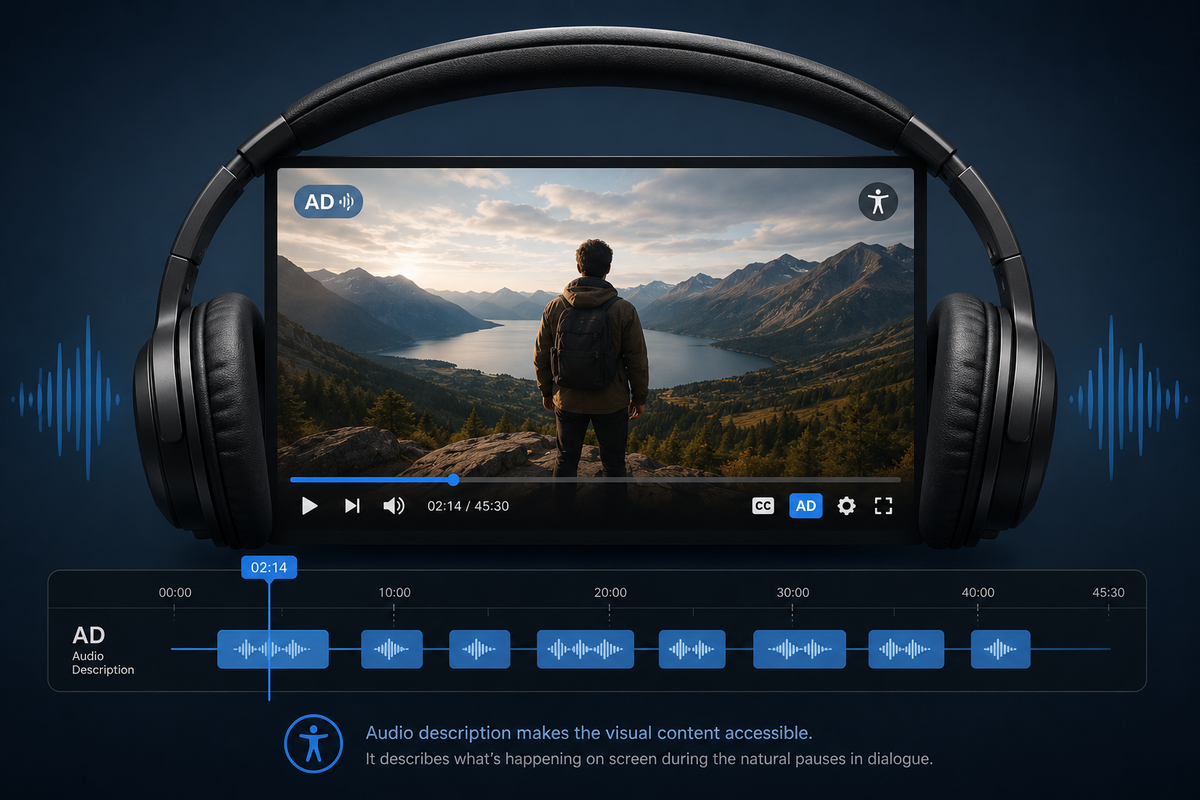
“Narration added to the soundtrack to describe important visual details that cannot be understood from the main soundtrack alone.”
This includes: actions, characters, scene changes, on-screen text, and other visual information that is plot-relevant or context-essential but not conveyed by the existing dialogue or audio.
Audio description is distinct from captions (which transcribe spoken dialogue for deaf users) and transcripts (which combine dialogue and description in text form).
WCAG Success Criterion 1.2.3 — Audio Description or Media Alternative (Level A)
Criterion: An alternative for time-based media or audio description of the pre-recorded video content is provided for synchronised media, except when the media is a media alternative for text and is clearly labelled as such.
Level: A (minimum conformance)
What This Means in Practice
At Level A, you have two options:
- Provide a full audio description of the visual content, OR
- Provide a text transcript that includes both dialogue and description of all visual information
The text transcript option makes Level A relatively easy to achieve — a detailed script or transcript satisfies the criterion even without a spoken AD track. This is intentional: Level A sets the floor, not the ceiling.
When Is a Transcript Sufficient?
A transcript qualifies under SC 1.2.3 if it accurately conveys:
- All spoken dialogue
- All non-speech audio (meaningful music, sound effects)
- All visual information relevant to understanding the content
For a film or narrative video, this means a very detailed transcript — not just a caption file.
WCAG Success Criterion 1.2.5 — Audio Description (Pre-recorded) (Level AA)
Criterion: Audio description is provided for all pre-recorded video content in synchronised media.
Level: AA (standard conformance target for most legal frameworks)
What This Means in Practice
At Level AA, the text transcript option is no longer sufficient. You must provide an actual audio description track — synchronised with the video and accessible to users via a media player control.
This is the criterion most commonly referenced in:
- The European Accessibility Act (references EN 301 549, which requires WCAG 2.1 AA)
- Section 508 of the US Rehabilitation Act
- CVAA (21st Century Communications and Video Accessibility Act)
- Netflix, Amazon, and Apple accessibility requirements for content delivery
Key Requirements for a Compliant AD Track
WCAG 1.2.5 does not prescribe style, but an AD track must:
- Be synchronised — description must appear at the correct point in the video
- Be complete — all plot-relevant visual information not conveyed by audio must be described
- Be accessible via the player — users must be able to enable/disable it without assistance
- Not interfere with dialogue — descriptions must fit within natural pauses or use extended AD where necessary
WCAG Success Criterion 1.2.7 — Extended Audio Description (Level AAA)
Criterion: Where pauses in foreground audio are insufficient to allow audio descriptions to convey the sense of the video, extended audio description is provided for all pre-recorded video content in synchronised media.
Level: AAA (aspirational; not required by most legal frameworks)
Extended audio description pauses the video to allow a longer description to be delivered, then resumes playback. This is used for information-dense sequences — rapid montages, action sequences, or data-heavy visuals — where standard AD cannot fit sufficient description in the available gaps.
Most content producers do not need to target AAA, but for educational or public information content, extended AD significantly improves comprehension for blind users.
What Does a Compliant Audio Description Script Look Like?
WCAG does not specify a style guide, but the most widely used standards are:
- ITC Guidance on Standards for Audio Description (UK)
- ADLAB PRO Guidelines (EU)
- Audio Description Coalition Standards (US)
- Netflix Timed Text Style Guide — Audio Description
All of these share common principles:
| Principle | Guidance |
|---|---|
| Tense | Present tense: “She opens the door” not “She opened the door” |
| Person | Third person: describe, don’t editorialize |
| Neutrality | Avoid interpretive language: “He looks angry” not “He is furious” |
| Precision | Be specific about visual details relevant to plot |
| Timing | Fit descriptions in dialogue gaps; never talk over dialogue |
| Consistency | Use character names consistently once established |
Common Compliance Mistakes
1. Providing Captions but Not Audio Description
Captions satisfy SC 1.2.2 (Captions for pre-recorded content) but do not satisfy 1.2.3 or 1.2.5. They are separate requirements. Many organisations assume captioning is sufficient — it is not.
2. AD That Doesn’t Cover All Visual Information
A partial AD track — one that describes some but not all visually-conveyed plot information — does not satisfy WCAG. Auditors test by watching with audio only.
3. AD That Overwrites Dialogue
AD descriptions that overlap with dialogue fail both WCAG and style guidelines. Descriptions must fit within gaps or use extended AD.
4. AD Track Not Accessible in the Player
If users cannot easily activate the AD track from the player controls (or via OS accessibility features), the requirement is technically not met even if the track exists.
How AI Audio Description Supports WCAG Compliance
Producing WCAG-compliant AD at scale has historically been the barrier. Traditional AD production for a feature film takes 2–4 weeks and costs €500–€1,500 per hour of content.
AI-powered tools like Synchrogen reduce this to minutes per video, with a script editor for human review to ensure completeness and WCAG conformance. The platform exports AD tracks in standard broadcast formats (ADM, audio stem, timed text sidecar) compatible with all major streaming delivery specifications.
Frequently Asked Questions
Is WCAG 2.2 different from WCAG 2.1 for audio description?
No. WCAG 2.2, published in October 2023, added new success criteria focused on cognitive and motor disabilities but did not change the audio description criteria (1.2.3, 1.2.5, 1.2.7). These have been stable since WCAG 2.0 (2008).
Does WCAG apply to mobile apps?
WCAG is designed for web content but is widely applied (and increasingly legally required) for native mobile apps. The EU’s EN 301 549 standard explicitly extends WCAG requirements to mobile applications.
Are there exemptions for short videos?
WCAG exempts media that is “a media alternative for text” (e.g. a video that duplicates a text article and is labelled as such). There are no general duration-based exemptions.
What level of conformance do I need for EAA compliance?
The European Accessibility Act references EN 301 549, which requires WCAG 2.1 Level AA as a minimum. This means SC 1.2.5 (audio description, not just transcript) is required.
Summary
| Criterion | Level | Requirement |
|---|---|---|
| SC 1.2.3 | A | AD track OR full text transcript |
| SC 1.2.5 | AA | AD track required (transcript not sufficient) |
| SC 1.2.7 | AAA | Extended AD where gaps are insufficient |
For most organisations targeting EAA or ADA compliance, SC 1.2.5 (Level AA) is the operative requirement: a complete, synchronised, player-accessible audio description track for all pre-recorded video content.